Friday, May 04, 2007

Symbols meaning 'reverse'

The great English numismatist Barclay Head used the ℞ symbol (Rx, the “prescription symbol” to mean “reverse.” For example, in his 1911 work Historia Numorum, p. 13, he says “Symbol on ℞. Club” while describing a coin with a club on its reverse. What is the name and origin of the symbol as applied to numismatics?

The Unicode standard calls the symbol “Prescription Take”. The Wikipedia page for Rx says that Rx is the symbol for medical prescriptions. (Wikipedia also gives a numismatic meaning: Rx means “tens of Rupees”).

The Straight Dope, Cecil Adams’ newspaper column, gives the medical history of the Rx symbol. There is controversy among pharmacy historians. There are three theories. 1. “Rx is an abbreviation for the Latin word ‘recipere’ or ‘recipe,’ which means ‘Take, thou.’”. 2. Rx is the astrological symbol for the god Jupiter. 3. Rx comes from the Egyptian symbol for the left Eye of Horus.

None of these sources explains why ℞ would be used in numismatic works to mean “reverse”. Barclay Head isn’t the only writer to use the symbol, it was also used by French writers Mionnet and Babelon in the 19th century. It is always followed by a period.


Another odd symbol was used in the 18th century. J. H. Eckhel used a symbol that looks like a cross between mismatched parenthesis, )(, and an asterisk to mean “reverse”. For example, volume 2 page 209 of Eckhel’s Doctrina numorum veterum (1792). I don’t know the name for this symbol, or if it was ever used non-numismatically. Eckhel also used )( without the decoration – perhaps his publishers didn’t have enough of the rare symbol to set type? At least one English-language author used the symbol in the reversed parenthesis form, R. S. Conway (The Italic Dialects (1897), for example p. 14).

Speculations: Eckhel’s reverse symbol is 1. a decorative version of actual mismatched parenthesis, 2. a decorative version of the Roman ‘Denarius Sign’ (an X with a line through it), or 3. a version of the Pisces astrological symbol without a space between the fishes. The problem with these theories is that the symbol doesn't look much like any of them. Pisces makes the most sense, as the Pisces symbol is supposed to represent two connected fishes swimming in opposite directions.

I would enjoy corresponding with anyone on this topic.

Saturday, April 28, 2007

Coins that are difficult to catalog


Some coins are difficult to catalog, because scholarship is not in agreement about the origin. The attribution of this coin is apparently insecure.

An anonymous cataloger (Künker auction 97, March 2005, lot 897) attributes to Euagoras II, 361-351 BC, Salamis Mint. Cites Babelon (Les Perses Achemenides (1893), #191) and Koray Konuk (SNG Kayhan 1066). The cataloger hedges saying an alternate is an uncertain Cilician mint.

Another cataloger (CNG, MBS 67, September 2004, lot 825) attributes to Datames, Satrap of Cilicia and Cappadocia. 384-362 BC, citing George Hill (BMC Cilicia (1900), pg. 100, 25) (as Mallos) and Babelon, (Les Perses Achemenides (1893), #191).

A similar coin is fancifully attributed to “Memnon, Satrap in Ionien (?)” in Nachfolger auction 376 (October 2003, lot 357). This attribution was not satisfying; a similar coin (auction 386, April 2006, lot 256) was catalogued as the satrap Mazaios, 361-334 BC, struck at an uncertain mint but possible Tarsos; citing Axel Winzer (Antike Portraitmünzen der Perser und Griechen (2005)).

A Baldwin’s cataloger attributes one of these (auction 34, October 2003, lot 84) to “Caria/Ionia, uncertain mint, satrapal coinage, time of Artaxerxes III, c. 358-340 BC” citing “Traité p.167, 30; Head, Coinage of Lydia and Persia, pl.III, 27, Pharnabazus”

Tuesday, April 24, 2007

Saturday, April 21, 2007

Athens - Sparta - New York


The three irregular lines are supposedly the traditional spit coinage of Sparta. The originals are in New York City for the next three weeks, as part of an exhibition, Athens-Sparta, at the Onassis Cultural Center, 645 Fifth Avenue.

Admission is free. There is a lot of amazing pottery and scuplture, nearly all from Athens or Sparta.

I was also excited about some metal toy soldiers and mythological monsters. The exhibit card said the figures had some votive purpose. Maybe they are found in temples, but I still think they are toy soldiers. A lot of Christian churches keep a room full of toys, and not for any religious purpose other than to get parents to come to Bible study class.

Anyway, the coins. A very nice group of Athenian coins, including one of the ANS's dekadrachms. Most (all?) denominations of the Athena-owl coinage are on display, including the tiny fractions.

There is also a group of coinage spits of Sparta. I have no idea how archeologists tell these spits from cooking spits, it wasn't explained in the exhibit. (There is a very nice $30 catalog of the show but I didn't get it.)

A Syracusan dekadrachm is also present. I don't know why. It is on display in the middle of the Athenian coins. It kind of looks out-of-place. I never thought I'd turn down seeing a dekadrachm but the Athenian coinage would have been more impressive without the Sicilian invader.

Wednesday, April 18, 2007

The Bill Wyman Signature Detector

Bill Wyman quit his band, the Rolling Stones, 15 years ago. He now writes about antiquties (Bill Wyman's Treasure Island) and recently designed a new metal detector.

This is a great development. We need more numismatic authors and antiquities experts. If you are in a band, maybe The Who or Pink Floyd, now is your chance to do something important like writing literature.

While researching this story (looking at the Wikipedia entry for Bill Wyman), I learned that he was his own grandfather. You blow my mind, Bill Wyman.

Tuesday, April 17, 2007

Friday, April 13, 2007

CNG 75


The CNG 75 auction is online. 570 book lots, 575 ancient Greek lots, etc., etc., etc.

(Update) The most interesting coin is lot 392, a fourée electrum 1/24 stater. The anonymous cataloger tells us that this coin proves the same mint made good and fourée coins. It would be interesting to re-examine the good specimens in light of the new piece!

Wednesday, April 11, 2007

More auctions

The Numismatica Ars Classica auction 39, auction 40, and auction R catalogs are online. The highlight is lot #8, an Akragas tetradrachm, although there is an Athenian dekadrachm with a higher estimate. Closing May 15, 2007.

The Hess-Divo auction 307 catalog is online. Closing June 6, 2007.

Monday, April 09, 2007

Gerhard Hirsch Nachfolger catalogs online

The Gerhard Hirsch Nachfolger auction catalogs 250 and 251 are online. They also arrived in the mail today. The auction 250 catalog is hardcover and celebrates the 125 anniversary of Hirsch (1878-2007). The coins are very high quality.

55 lots of ancients in auction 250 and about 600 in auction 251.


I was just thinking about Hirsch's illustrious history this afternoon. I know they sold Imhoof-Blumer's collection in 1907. 2515 lots. I have a lot of photocopies of Imhoof-Blumer's works, and they often describe a rare or unique coin, unpictured, and say "M.S." which is German for "My Collection". It would be a nice catalog to have, or to have a CD-ROM of. I've never actually seen a copy, although the ANS has one.

19th century Numismatic Chronicles

Google recently added a bunch more full-view and downloadable issues of the Numismatic Chronicle. Most of the 1850s issues are now available. I've updated my web page on available issues. The new issues were scanned at the UofM and the Bodleian. Thanks.

Google is still blocking most non-US countries from this material. At the bottom of my NC page is a link to access my page through a US proxy. Use that. My favorite proxy is now running advertising banners, but it isn't bad.

Sunday, April 08, 2007

The Baldwin's catalogs for the April 24-25th auctions are online

The auctions are #50, #51, and 'Islamic #12'. The Islamic auction is at Sixbid.com as interactive HTML and on Baldwin's usual website in PDF format. Baldwin's is in London but their website address is baldwin.sh, suggesting they are located on the South Atlantic Isle of St. Helena! Do not be fooled. If you are in London it is worth stopping in; I was able to get a copy of SNG Levante Supplement inexpensively three years ago there.

Auction 50 is Ancient, British, and Indian coins. Only 205 ancients, but one is an Athenian dekadrachm!

Auction 51 is foreign, medals, and books. There are only about 150 lots of books but many are group lots with several titles, and the selection of books on Indian numismatics is good.

I got the auction 50 catalog in the mail with an offprint of 51 containing just the books. I've never seen an auction offprint before. It is a good idea; books descriptions don't need to be printed on super-glossy paper. It also saves space, because I don't need the medal catalog.

Monday, April 02, 2007

Medialia

I visited the Industrialization exhibit at Medialia on Saturday. I'd like to recommend the show, but Saturday was the last day.

The show presented art and historical medals on the theme of industrialization. I enjoyed the show, which occupied two glass cases in the small gallery, as well as the permanent medal collection. My favorite pieces were some Japanese medals what seemed like a traditional style, and a Soviet space medal showing the Baikonur Cosmodrome behind Kazakh peasants.

Medialia is a gallery selling fine art sculpture. All the pieces are small, and most are what I'd call art medals. Until last week, I was unaware that New York even had a medal gallery. I've been to most of the shops that advertise in the ‘Coin and Stamp Dealer’ category in the phone book or whom show at the few local coin shows. Medialia doesn't do either. It appears in the phone book under ‘Antique Dealers’ and ‘Art Galleries & Dealers’.

I didn't know how to behave in the shop. When I'm in a coin dealer, I know that nearly everything is for sale, and that anything I'm not allowed to touch will be in a protective slab or 2x2. At an art gallery, one never touches anything.

I was given a free catalog of the show. It wasn't on glossy paper but it was still nice — and something one doesn't get at coin shops. The catalog seemed like something that medal and numismatic literature collectors would want, but I've never seen a Medialia catalog in a coin book auction and the ANS library appears to lack them as well. So, the catalogs are a new offering or great rarities.

At Medialia, only a few of the items had prices. The prices seemed high to me, but the medals offered were mostly better than the $50 medals I've bought at coin shows and on eBay. I plan to go back again, and learn about art medals. The space seems to host a lot of short shows. I picked up an announcement about an opening this Saturday, but the details are not yet on the web site.

Saturday, March 31, 2007

Bootleg Bulletin on Counterfeits

I received the bootleg Bulletin on Counterfeits yesterday.

Although ‘Microbe’ promised a pressed CD all I received was an unlabelled CD-R.

The CD-R contains the 1976-1999 run, as JPEG files, two pages per file. The pages were scanned at 150dpi. The pages are quite readable, although on some years there is bleed-through from the other side of the page. (Recommendation: put black construction paper between pages while scanning to counteract this scanning flaw.)

The disc also contains a 21 page MS-Word format index. The index is broken down by category (Greek Silver through Modern). The contents of each category are sorted alphabetically by city or country. It's useful, but an improvement would be an HTML document that hyperlinks to the individual page files.

I don't know if the bootlegger wrote the index or if he merely acquired it elsewhere. This index is different from the partial index at the Lakdiva site. I hope the author puts it online.

Wednesday, March 28, 2007

German translation

A lot of numismatic books are written only in German. I don't read German, but I need to read German coin descriptions. Here's what I do.

The first step is to type in the German text. It's important to get accents right. Use Windows Character Map (Linux has something similar) or the 'Insert Symbol' feature in Microsoft Word. Then I feed the text to Google Language Tools for a very rough translation.

Google is lacking a lot of words. There are four dictionaries I use. For coins, Münzen Lexikon is useful. There are also two big general German-to-English dictionaries online, LEO and The New English-German Dictionary.

There is also a Wiki translating dictionary, Wiktionary. If none of the above dictionaries have the word I can go there and enter requests for English definitions of German words by volunteer translators.

The text that comes out of Google is often poor, especially because without a numismatic dictionary Google doesn't even know the parts of speech. However, I can hand-edit the text into something readable, especially if I have a picture of the coin being described to refer to.

Other multilingual numismatic glossaries are Wörterbuch der gebräuchlichsten Fachausdrücke für Münzsammler and Moruzzi Numismatica glossary, but I rarely have luck there.

For abbreviations, like "pkr" (= perlkreis) I have to ask for the full word on an ancient coin website.

Sunday, March 25, 2007

LHS and Tkalec catelogs online

The LHS auction 100 and Tkalec 2007 auction catalogs are online. The LHS auction is April 23/24th and the Tkalec is April 22nd.

Monday, March 19, 2007

Information wants to be $35

On Friday a Yahoo account named 'Mike Robe' (=microbe) offered CD-ROMs containing the entire run of “Bulletin on Counterfeits” and an index, for $35. The offer sounded bogus, but initial reports said it was legit.

The web site hosting the offer is now gone, and the seller claims his run of 25 copies sold out.

Reid Goldsborough reports that the IAPN is now considering selling a legitimate CD-ROM. No word on availability or price.

Reid concludes his message with a screed against freeloaders, saying “If I and others aren't paid for some of our work, if everything is free for the taking, guess what's going to happen to the quality of information available.”

I wish it was that simple.

I'm told that most books on ancient coins do not recoup their printing costs. Authors who have the support of a press willing to take a loss can get paid. Everyone else has to self-publish. Under these conditions it makes sense to write for free. Why would anyone want to earn NEGATIVE $7000 publishing a book? Better to put it online and only lose $10/month.

There isn't much money in numismatic writing. I've heard that RPC volumes 8 and 9 are done but there is no money to pay for publishing. The publishers of Agoranomia tell me they don't like putting 'coins' or 'coinage' in titles because it discourages libraries from buying! We are in a period in history when there is very little interest in old coins. I don't think the lack of interest is because of file-sharing. No one has offered me digital copies of RPC!

Publishers are free to charge whatever they want. A pirate who named himself after H5N1 Avian Flu sold 25 copies of BoC and made about $30x25=$750 profit last week. The IAPN made a business decision to price BoC at over $500 and probably made $0 last week. I'd rather the IAPN get the money, but that's now how economics works.

The musician Frank Zappa was very clever. Pirates released albums of his concerts. Frank took their packaging and sold it himself. The IAPN could turn around tomorrow and sell microbe's package.

I bought the IAPN's book on The Caprara Forgeries and was paying $60/year for “Counterfeit Coin Bulletin”. I thought Caprara was worth the money.

The recent incarnation of the Bulletin was not worth $60/year to a collector. It was mostly pictures of US fakes with arrows pointing to die flaws. No interesting text. To a dealer, $60 may be a bargain. Collectors don't see it that way. One suggestion is to charge a lot of money for current issues, and make additional money selling last year's issues to collectors at a lower price.

Tuesday, March 13, 2007

New software for 'scanning' with digital camera

Teleread's Branko Collin briefly discusses Snapter, new software to improve digital photographs of books making pages look scanned.

A free trial of Snapter is available from the Atiz website.

New book on forgeries

SP-P has announced a new book by I. Prokopov, Coin Forgeries and Replicas 2006. I haven't seen this book yet. The earlier books in the series are good.

The book publishes 201 fakes, including a 20 page catalog of fake Histiaea tetrobols.

Monday, March 12, 2007

New discounts from David Brown Book Company

The David Brown Book Company is discounting these titles:

Caesarea Maritima: The Coins and the Hellenistic, Roman and Byzantine Economy of Palestine by Jane DeRose Evans
$68.00 (list $84.95)

Agoranomia: Studies in Money and Exchange Presented to John H. Kroll edited by Peter G. van Alfen
$100.00 (list $125.00)

Roman Provincial Coinage VII: Gordian I to Gordian III (238-244). Première partie. Province d'Asie by Marguerite Spoerri Butcher
$192.00 (list $240.00)

Roman Provincial Coinage, Volume I by Andrew Burnett, Michael Amandry and Pere Pau Ripollès
$260.00 (list $325.00)

Sylloge Nummorum Graecorum Deutschland 14: Attika - Megaris - Aegina
$76.00 (list $96.00)

Sylloge Nummorum Graecorum Deutschland: Syrien: Nicht-koenigliche Praegungen
$132.00 (list $165.00)

Islamic History Through Coins: An Analysis and Catalogue of Tenth-Century Ikhshidid Coinage by Jere L Bacharach
$22.00 (list $24.50)

Money of the Caribbean edited by Richard G Doty and John M Kleeberg
$52.00 (list $65.00)

Coins of the Holy Land: The Abraham D. Sofaer Collection at The American Numismatic Society by Ya'akov Meshorer et al.
$120 (list $150)

Sylloge of Coins in the British Isles 55: Hermitage Museum, St Petersburg Part IV. English, Irish and Scottish Coins, 1066-1485 by Marina Mucha
29.98 (list $85.00)

Ancient Greek Coins: Catalogue of the Classical Collection, Museum of Art (RI) by Ross Holloway
14.98 (list $50.00)

Ancient Jewish Coinage: Vol. 1. by Ya'Akov Meshorer
9.98 (list $45.00)

Catalogue of the Aksumite Coins in the British Museum by Stuart Munro-Hay
49.98 (list $117.00)

Coin Hoards IX. Greek Hoards Meadows, Andrew
79.98 (list $130.00)

Zecca: Mint of Venice in Middle Ages by Alan M. Stahl
19.98 (list $79.00)

Coinage and Identity in the Roman Provinces edited by Christopher Howgego, Volker Heuchert and Andrew Burnett
59.98 (list $150.00)

The Coinage of the Atrebates and Regni by Simon Bean
19.98 (list $50.00)

Coins (Interpreting the Past) Burnett, Andrew M.
4.98 (list $12.95)

Humphrey Cole: Mint, Measurement and Maps edited by Silke Ackermann
9.98 (list $27.00)

Metal Analyses of Roman Coins Minted under the Roman Empire by L H Cope, C. E. King, J. P. Northover and T. Clay
9.98 (list $22.50)

Studies in Greek Numismatics in Memory of Martin Jessop Price edited by R Ashton and S Hurter
39.98 (list $150.00)

Sylloge: (SNG ANS 6) Palestine-South Arabia Meshorer, Ya'Akov
14.98 (list $125.00)

Sunday, March 04, 2007

Should fake antique dealers be punished?

Writing for China Daily, Li Qian asks Should fake antique dealers be punished?

“A fake ancient coin dealer was sentenced to three years in jail and fined at a Nanjing court days earlier, causing an uproar in the collections [sic] society...”

“Experts estimate as many as half of antiques dealers would face jail terms in China if the country punishes them using current laws for common businesses...”

“Fake antique articles have left many collectors suffering from hefty losses, as the technological trend of counterfeiting becomes a headache for even the most experienced experts ... Some [forgers] raise bugs and mice to bite on scrolls to make them appear ancient.”

Thursday, March 01, 2007

Elsen auction 91 online

Jean Elsen's auction 91 catalog is online, with 474 ancient coins. There are also many 'siege coins'.

Tuesday, February 20, 2007

Tom Cederlind Buy or Bid sale 142

Tom Cederlind's Buy or Bid Sale #142, with 358 lots, is online now. Closes April 5th.

Monday, February 19, 2007

Copyrighting individual coin descriptions

The e-Sylum reported yesterday on David Hewett's story on the auction description copyright lawsuit between Heritage and Superior.

Hewett's article shows examples where the same word patterns are used first in Heritage catalogs and then in Superior catalogs, for example in describing an 1879 gold Stella:

The regal beauty of this curious denomination has kept demand very high for an attractive example, such as the coin offered here, and many numismatists have long desired to own such a prize. However, the price of ownership seems to continue to outpace all but those who greatly desire and can afford the cost required to secure an example. Here is an opportunity for yet another collector to fulfill the dream of finally obtaining one of America’s most popular and unusual denominations ever produced.

Heritage, February 23, 2005


The regal beauty of this curious denomination has kept demand very high for an attractive example, such as the coin offered here, and many numismatists have long desired to own such a prize. However, the price of ownership seems to continue to outpace all but those who greatly desire and can afford the cost required to secure an example. Here is an opportunity for yet another collector to fulfill the dream of finally obtaining one of America’s most popular and unusual denominations ever produced.

Superior, September 29, 2006


The problem is that Superior hired an ex-Heritage cataloger, James Jones. It is difficult for a person not to sound like himself when describing the same coin type! This case reminds me of the famous "stealing from himself" lawsuit against rock singer/composer John Fogerty. In that case, a manager who owned part of an old song's copyright sued the singer for rights to a new song that sounded a lot like the old one.

Collectors want the descriptions of similar coins to look similar. If every cataloger put creativity into every description there would be no way to compare descriptions. For example, one of the examples in the suit uses “glossy chocolate-brown surfaces” to describe a colonial Vermont copper. We don't want one dealer using 'chocolate-brown', another using 'coffee', another using 'mocha', another using 'mahogany', etc.

For longer prose descriptions like the Stella quote above it may make sense to ban re-use of descriptions by catalogers who change firms. I don't know. I don't want a large settlement scaring other auction houses into bizarre sentence construction and new adjectives. (I'd also like to see catalogers get bylines on catalogs.)

Israel cracks down on delinquent diggers

A short item by Roger Atwood on Israel's demands that licensed diggers publish their findings. (via PhDiva, who notes that Egypt adopted a similar policy.)

Atwood's book on looting was recently remaindered and can be purchased cheaply at Oxbow books.

United States bans collecting of military medals

The United States banned collecting of military medals on December 20, 2006. It's illegal to purchase, sell, mail, ship, import, or export any service medal, badge, ribbon, or imitation.

A long article by David Hewett in the March issue of Maine Antique Digest covers the law and the response in the medal collecting community.

http://www.maineantiquedigest.com/articles/mar07/medals0307.htm

The anti-collecting law was part of the Stolen Valor Act, an attempt to ban the practice of fraudulently wearing unearned medals. The anti-collecting provisions were the result of over-zealous bill-writing. The article says the Orders and Medals Society of America (OMSA) had its members contact their representatives, which was almost successful -- there were promises of changing the wording of the bill to allow collectors and museums to continue acquiring the pieces. Unfortunately the law passed with the original anti-collector anti-museum wording.

The OMSA website carries further details.

I am surprised that this law was proposed, debated, and passed without my knowledge. I first learned of it this morning!

I do not support con men wearing imitation Purple Hearts but it should be legal for a soldier or heir to donate medals to the local history museum and send them the medal to the museum through the US mail. It should be legal to make and sell replica medals to Hollywood directors making war movies. Schools where they train engravers to make future medals should be able to obtain representative styles of medals. Why not just keep capitalism legal, and ban merely the practice of wearing a medal with intent to deceive?

Sunday, February 18, 2007

New accusations in Veliko Tarnovo Museum coin robbery


Michel van Rijn has a new post on the Veliko Tarnovo Museum robbery of last year, written by Arthur Brand. Van Rijn's site links to this blog because we wrote about Bulgarian reports last year. Brand's post claims to give the names of the robbers. It also claims the coins were moved through eBay sellers 'Pagane' and 'Silenos'.

A better source than this blog for details on the case is this FORVM post.

I haven't been keeping up with the story but there doesn't seem to be anything new other than Brand's accusations. Google has a new News Archive Search; searches there for /Veliko Tarnovo robbery/ offer few details. Most of the details are behind paywalls, and seem to be repostings of the material that came out early last year.

The Sofia Echo claims to have reported, in April, on calls for the museum director to step down. Apparently he did; in September the Echo suggested that the proposed new director of the museum, Hristo Haritonov, might be underqualified. That doesn't make any sense, because Mr. Haritonov was already the director! Perhaps the dates are wrong on the Echo's web site, or I misunderstood before and Mr. Haritonov did get a promotion in August.

(Mr. Haritonov is a numismatist and writer. His books include Coins in the Bulgarian Folk Culture (c. XV-XVII). He also wrote the paper “Semiotic Aspects of the Monetary Iconography in the Context of the Medieval Bulgarian Culture” which was published in the museum's journal.) I have never read these books and would be curious to know if they are highly regarded.)

Anyway, both the police and museum claim to have photos of the stolen coins. It should be a simple matter to check eBay's records. I would have preferred the release of the photos allowing the public to help in the search. Maybe Brand is wrong and the coins are still out there? It would be wonderful if Brand has cracked the case but I am skeptical. I don't recall these eBay dealers moving a better or different product than their usual offerings any time in 2006.

I look forward to more details as they are uncovered.

Thursday, February 15, 2007

Harlan J Berk sale 153

Harlan J. Berk sale 153 is online. 442 ancient coins, plus antiquities.

The catalog arrived today. If there was an email announcing this sale I missed it.

Thursday, February 08, 2007

Numismatic literature

This month's Celator contains a full-page 'People in the News' segment on new firm Douaglas Saville Numismatic Books. Kerry Wetterstrom talks highly of Saville's FPL No. 1.

A highlight of the FPL is the complete set of 17 Ars Classica/Naville auction catalogs bound in eight volumes (£2200). Kerry Wetterstrom, apparently quoting Saville, calls this series the “single most important series of auction sales relating to Greek coins ever published.”

I wonder why? Although I've seen the catalogs in person at Charles Davis's NYINC booth I've been afraid to open them up and look at them. What makes them worth $200 each?

These catalogs have about 1500-3500 lots and 30-100 plates. That was a lot of photographs for their day, but modern catalogs reach that. Modern catalogs are in color and free.

Some auction catalogs are purchased by literature collectors who want the catalog as an object. I am interested in catalogs for the information they carry. A finite budget forces me to be selective. How shall I choose which old catalogs to acquire?

Warren Esty's site discusses the merits of ancient coin auction catalogs. Mr. Esty has done a great service to the coin collector by inventing a series of codes to compactly describe the focus of ancient coin auction catalogs. For each catalog in his collection he tells us how many Greek, Roman, Byzantine, and Celtic coins are presented. He has also invented codes for the quality of the coins inside (he uses MV, HV, and VHV, which mean $, $$, and $$$!) and for the presentation of the catalog (photography, printing, etc). If a catalog has a special focus (a city or denomination) he calls that out.

I wish book dealers would adopt Mr. Esty's codes.

Hiding valuables in your home

A burglar offers advice on hiding valuables.

Wednesday, February 07, 2007

Gorny & Mosch auctions 155-7

Gorny & Mosch auctions 155, 156, and 157 catalogs are online. Auctions are held 5-8 March 2007.

Friday, February 02, 2007

Kolbe auction 102

The Kolbe auction 102 catalog is online. 707 numismatic books. Closes March 15th.

Thursday, February 01, 2007

Books (non-numismatic)

Forbes: The 10 Most Expensive Books Of 2006 (via Books Found blog).

Half of the top ten were geographical works by classical authors!

There is a $10/month service called ScoutPal that allows you to look up Amazon Marketplace value of books and CDs from your cell phone.

Slang of the Book Trade: part one and part two, from the great new Bookride blog.

Wednesday, January 31, 2007

Coin database formats

The Vatican Library's coin collection is coming online, with photographs. Many papal coins and medals are already viewable. The Vatican has chosen to use MARC 21 as their metadata format.

A coin database needs fields for the attributes that can be searched. Sebastian Heath and Andrew Meadows have created the Numismatic Metadata Project to determine the ideal fields for numismatic metadata.

Existing databases, like the Moneta, ISEGRIM, and Tantalus Coins (no direct link to their database format) use whatever fields the authors and users wanted.

For librarians and computer scientists this is a problem. It makes it difficult to combine databases when the fields have slightly different meanings. I wish Heath and Meadows success in uniting the field with a single proposal with strictly defined meanings for each field.

Achieving concensus on design is difficult because different users expect different things. For example, I often use coin databases to identify coins from partial inscriptions. I'd like a numismatic database to contain information on individual letter characteristics, such as serif vs. sans-serif, and orientation (vertical, horizontal, clockwise, etc.) Most users won't want to even see that on the screen - so why put it in the database?

Monday, January 29, 2007

Restrictions on Cypriot coins

By now you've read that the government of Cyprus wishes to add 'coins more than 250 years old' to the list of restricted cultural objects making it illegal to import such items without a license from Cyprus and requiring our Customs and Border Patrol to be on the lookout for such coins.

Hopefully you've also read Wayne Sayles' response.

I'd like to see a world where numismatists can send coins across borders for study — a Numismatic Free Trade Agreement — and don't like it when governments try to restrict the sale of old coins.

This agreement is more than just a restriction that burdens coin collectors. Adding coins to Cyprus' list means that our customs agents will need to learn to recognize the coins of Cyprus.

Customs is a hard job. (Here is a nice How Customs Works that explains what the officers do.) It's best if the list of things the agents need to monitor is small. It isn't hard to recognize a gun or a brick of cocaine. Recognizing Cypriot coins is harder than detecting guns. Obviously a smuggler isn't going to write 'auto parts' on a shipment of coins. He is going to write something like 'recent silver tokens'. The Customs agent will need to study the difference, leaving little time to look for guns and bricks of cocaine.

When the Iraqi museum was robbed the state department put out a list of stolen Iraqi artifacts, including coins. This was a problem, because no coins were stolen! The list is still there, but now says 'Present, Stolen or Missing'. (Coins are 'Present', but you wouldn't know it from the site.) Look at the 'Islamic Coins' and 'Parthian Coins' on that website. This is the kind of information that will be given to Customs agents.

There is a pre-existing agreement for Byzantine metal antiquities with Cyprus; the images are here. If coins are added you can expect to see 'Greek', 'Byzantine', and 'Medieval' coins added to that list. Having coins on the list means Customs Agent will be spending a lot of time opening boxes when the X-ray shows coins. Recent and old coins look similar under the X-ray.

More Google

Jeffrey Toobin reports on Google's Moon Shot in next week's The New Yorker.

According to the article, Google plans to scan at least 32 million volumes, and be finished within ten years. The article estimates the cost of this at $800,000,000; elsewhere I've read numbers as low as $100,000,000 million.


“Previously, when people have done scanning, they always were constrained by their budget and their scale,” Clancy told me. “They had to spend all this time figuring out which were the perfect ten thousand books, so they spent as much time in selection as in scanning. All the technology out there developed solutions for what I’ll call low-rate scanning. There was no need for a company to build a machine that could scan thirty million books. Doing this project just using commercial, off-the-shelf technology was not feasible. So we had to build it ourselves.”


A few years ago I was begging Frank Campbell to let me scan some titles at the ANS library. He had so many concerns I hinted that it might be better for me to just wait for Google. Frank seemed surprised that I would believe Google would scan numismatic works and auction catalogs.

As the article implies, Google doesn't have a choice. They cannot afford to decide which books are worthy of scanning. At $30 to scan a book it's cheaper to scan than to pay a graduate student to decide which books are worth scanning! If librarians in any of Google's member libraries thought a title was worth acquisitioning then it'll be on Google.

What won't be there? 20th century auction catalogs? Anything else?

In related news, Google's copyright lawyer has a blog.

Friday, January 26, 2007

Maps from books


Google's blog announced yesterday the addition of automatically generated maps for books.

For example, suppose you are reading the anonymous catalog International Medallic Exhibition of the American Numismatic Society. Click on 'About this book' and a new section, 'Places mentioned in this book' appears. It's a map of the world, with red pins sticking into it.

One of the pins is over Texas. Hover over the pin and a tooltip reading "Sabine Pass, Texas" appears. Click on the Texas pin and a balloon appears with an excerpt showing the details of medal 3395 and a page number. Click on the page number and page 242 appears with 'Sabine Pass, Texas' highlighted.

Not only is the technology amazing, but completely automated. No bibliographer typed in a list of cities into Google. An Artificial Intelligence figured this out on its own.

The flaws in this techology are obvious. Also on page 242 is a Washington medal of New Orleans, but New Orleans doesn't appear on the map. Presumably Google's software is looking for "(city), (state)" and "(city), (country)" patterns. It hasn't yet been taught the "(important city)" pattern.

It's an important start. I look forward to that day when Google can extract the ancient cities - polis - and map Greek coin books.

Thursday, January 25, 2007

Counterfeit detection pens

Excellent article on how counterfeit detector pens work.

The pens detect the starch content in money. Regular paper has starch, currency paper doesn't.

Magician and skeptic James Randi uses an ironing product, spray starch, that makes genuine bills appear counterfeit. Then he returns the starched bills to the bank. Eventually someone will attempt to pass the genuine but starched bill, leading to police, siezed money, etc.

Wednesday, January 24, 2007

Legal and Ethical Issues in Ancient Numismatics

I hadn't noticed this before, but last year the ANS added 'Legal and Ethical Issues in Ancient Numismatics' to the reading list for the Eric P. Newman Graduate Seminar. (This is the seminar the ANS offers on numismatics to graduate students in related fields like Classics and Archeology.)

It's an interesting list.

The ANS's own statement on cultural property is here.

Tuesday, January 23, 2007

Sonic Fingerprints Safeguard Art

A report by Nicole Martinelli, Sonic Fingerprints Safeguard Art, discusses Pietro Cosentino's invention of 'sonic fingerprinting' for antiquities.

Professor Cosentino attached sensors to an ancient funeral url, then tapped the urn with a small rubber hammer. The sensors recorded the vibrations. The idea is to create a 'fingerprint' of the interior structure of the urn.

According to the report, the technique works on stone, wood and ceramics. Not metal, so this wouldn't be a good technique for examining ancient coins.

Ancient coins has a similar technique called the 'ring test'. The coin is struck and a human listens for a ringing sound. Reid Goldsborough explains the test. It's used for detecting cast counterfeits and to check for crystalization.

Could a quantitative test be developed for ancient metallic objects? Perhaps something with a tuning fork and very accurate measurement of sound waves or object vibrations? I suspect such a test would reveal very little about coins of good metal, but perhaps would be of use for measuring crystalization or patina composition.

(via Harvard Art Law News).

Monday, January 22, 2007

“I'd like nothing better than to do a film on the antiquities trade.”

Part 2 of Suzan Mazur's interview with Bruce McNall.

McNall talks about the antiquities market, Hecht, Numismatic Fine Arts, and the Hunt brothers, as well as his new movie Alpha Dog starring Bruce Willis, Justin Timberlake and Sharon Stone.

Sunday, January 21, 2007

Right Wing Coin Geek

Dealer Jim McGarigle (Polymath Numismatics) has a new blog, Right Wing Coin Geek. In today's post he explains how he prices ancient coins. He also touches on misattribution and rarity.

Friday, January 19, 2007

Priceless mirror makes smashing TV debut

Ouch! IOL reports that a bronze mirror from the Warring States period, 475-221 BC, fell out of its box while being held by an assistant during taping of a Chinese television program.

Although priceless, the owner Chen Fengjiu had previously been offered $1,000,000 for the mirror.

Freeman and Sear FPL 12

The printed catalog for Freeman and Sear Fixed Price List 12 arrived yesterday. 190 lots. The catalog features coins with fine portraits of rare rulers, including this tetradrachm of Cleopatra and Marc Antony.

Thursday, January 18, 2007

The famous catalogue of the Burlington Fine Arts Club Exhibition of Ancient Greek Art

Alan Walker of LHS Numismatik gave a fascinating talk on “Famous Collectors of Greek Coins” last Saturday at NYINC on behalf of the ACCG.

Walker told personal anecdotes about several 'name' collectors and described the auctions and catalogs of their coins.

The collectors were Photiades, Rhousopoulos, (Arthur John) Evans, Jameson, Pozzi, Clarence S. Bement, and Charles Gillet & Marion Schuster. Except for the Schusters I had heard all the names before but knew next to nothing about them. I vaguely knew that Evans had excavated linear-B tablets on Knossos and that Pozzi was a doctor who was murdered by a patient. The others were just names.

Walker's research into the people behind the names illuminated the collecting scene in the 19th and early 20th century. I was surprised that a lecture on coin collecting could be as interesting as the coins.

Although these collectors were not or have lost universal fame they are famous enough in numismatics to have only 'one name', justifying the 'Famous' in the title.

Describing Evans's coins, Walker says “... 211 of Evans's coins, all from Magna Graecia and Sicily save for nine from Crete, were published by G. Hill in the famous catalogue of the Burlington Fine Arts Club Exhibition of Ancient Greek Art held in 1904.” [emphasis mine].

Walker might have used 'famous' in jest, but I suspect he believes Hill's catalog is truely famous. Perhaps to the people who were in the room the catalog is famous.

(Walker makes an error; I believe the exhibition was held in 1903 and published in 1904. The Historia Numorum (1911) bibliography gives 1903 as the publication date. The ANS library catalogue entry holds both dates. Clain-Stefanelli's bibliography doesn't have an entry for the catalog.)

I've never seen a copy. The ANS library has one but it must be in the rare book room — I've never seen it in the regular Greek coinage stacks. I've never seen it offered for sale at a coin show. I don't recall it listed in any auctions of numismatic literature. Google hasn't scanned it. Clain-Stefanelli's bibliography doesn't list it and neither does Kroh's. 'Obscure' is a better description for the catalog.

I only know of the catalog because Historia Numorum cites it twice for tetradrachms of Sicily. For years I've fantasized annotating my Historia Numorum web site with photos, including the two from Hill's Burlington catalog.

If there is a community of numismatic bibliophiles for whom this catalog is famous I need to meet these people and hang out with them.

Hirsch auction catalog online

The Gerhard Hirsch Nachfolger auction catalog is now online. Antiquities, ancient coins, and over 600 lots of numismatic literature. (Mostly covering German coins, though.)

The web site is a bit difficult to navigate. I received the printed catalogs in the mail yesterday.

Tuesday, January 16, 2007

Interview with Bruce McNall on Roman Bronze Boy

Suzan Mazur has a brief interview with Bruce McNall on the Scoop website.

The interview implies the difficulty of forensic testing of bronze antiquities. Robert Hecht is mentioned.

Sunday, January 14, 2007

Joseph Eckhel, Doctrina Nvmorvm Vetervm

I purchased two books this week. The first was Broome's A Handbook of Islamic Coins. Spink has reprinted it, and was selling it at NYINC for $50 although I couldn't find it on Spink's web site. (Used copies of the 1985 edition run about $300).

The other title was Antiquarian Books on Coins and Medals by Bassoli. This short book (88 pages) includes a 3 page chapter on abbot Joseph Hilarius Eckhel, author of the landmark Doctrina Numorum Veterum (1792-1798) (in Latin). This chapter begins with an odd anecdote about Eckhel refusing to use his connections to find his newphew a job, saying “anyone who can [read, write, and count] properly needs no other recommendations, and can make his way in life off his own back.”

I can't read Latin, but I can puzzle through basic coin descriptions and a lot of 19th century books cite it. Curtis Clay has praised the work. It was last reprinted in the 1830s, and is expensive. Spink wants $5000 for "a very fine set" "perhaps the very best set we've seen"; I couldn't find another copy for sale. So it's good news that Google has provided us with a digital copy:

Greek
[vol 1]
[vol 2]
[vol 3]
[vol 4]

Roman
[vol 5]
[vol 6]
[vol 7]
[vol 8]

Bassoli says these books have “some tables of coins”. I couldn't find them on Google's site (but didn't look to hard.) If you are interested in Bassoli you'll have to order it from Kolbe or Spink. Regular online stores don't carry it. Online book searches for Bassoli only yield the original Italian edition, Monete e medaglie nel libro antico dal XV al XIX secolo.

Wednesday, January 10, 2007

Masked robbers steal $4 million in rare coins

The Miami-Herald reports Masked robbers steal $4 million in rare coins at the FUN show.

A witness told police she saw the Mitsubishi pull into the hotel ahead of her, blocking her from the entrance. Three men wearing dark hooded shirts and surgical masks got out, one holding the victim at knifepoint. He ordered the coin custodian, who worked for a Minnesota man that owned the valuables, to open the sport utility vehicle and slashed its back tire.

The dealer's name was not given in the report.

UPDATE: The Orlando-Sentinal has better coverage including a photo of one of the coins.

Google book search announces new library

Google book search has an official blog, Inside Google Book Search. Announced today: The National Library of Catalonia joins the Library Project.

The libraries' website has a searchable catalog, but it was performing slowly today. The library has a lot of Catalon and Spanish-language titles.

Monday, January 08, 2007

Jewish revolt coinage at Bi-Lo grocery?

WLTX, news channel 19 from Columbia South Carolina tells us Sumter Woman Finds Possible Ancient Coin In Grocery Change.

The coin looks fake, but coin expert Ken Lyles has dated it to Bar Kokhba's revolt.

Friday, January 05, 2007

More books on Google

A bunch of new titles have been appearing on Google. Google's book search engine remains broken. Although I've found four volumes of Eckhel's Doctrina numorum veterum Google believes there is only one! It's frustrating.

DNV is important. It would be a worthwhile project to create an HTML geographical index for it.

Most public domain books can be downloaded but a few can't. Here is an interesting one: The Money of the Bible (1894), by George C. Williamson. I am becoming interested in old woodcuts of ancient coins.

Print your own money

Official PDFs of Monopoly money.

Tuesday, January 02, 2007

Welcome to 1922!

Robert Nagel welcomes us to 1922.

If Sonny Bono hadn't extended copyrights, the public domain have received the works of 1931 this year. Titles such as the first SNG (SNG Spencer-Churchill), George Hill's Notes on the ancient coinage of Hispania citerior, and 353 other works.

Saturday, December 30, 2006

Thieves steal valuable art for scrap metal

An anonymous UPI report shows thieves in the US stealing art treasures for scrap. Dozens of bronze scuptures by John T. Scott were stolen from a warehouse in eastern New Orleans.

(Hat tip: Art Law News).

More details are given in a Times-Picayune story by Doug MacCash, 'Famed sculptor falls prey to thieves'. A followup offers a $5000 reward for information leading to the arrest and indictment of the thieeif (sic).

Photos of Scott's art are shown on the Arthur Roger Gallery web site, and there is a nice page on Scott at the Tradtional Fine Arts Organization site.

Ancient coin collectors sometimes argue that we shouldn't respect the export laws of countries which nationalized undiscovered antiquities. By buying coins we save them from the melting pot.

Even with our brick warehouses and honest police detectives art is being stolen and melted in the USA.

It wouldn't be ethical, for example, for a German to buy and keep Scott's hacked up sculptures to save them from the furnace. So the policy shouldn't be “It's always worthy to acquire smuggled goods to save them from the pot.”

Nationalized undiscovered coins are somehow different enough from named modern sculptures that different ethics should apply.

Thursday, December 28, 2006

Kolbe moving sale

George Kolbe Fine Numismatic Books is having a sale. The sale started on December 9th but I just found out about it.

A 16 page PDF catalog containing 1659 lots is online. Much of the material is highly obscure, specialist stuff, on ancient and modern coinage.

Mr. Kolbe is also offering 50% off many of his own titles, for orders before December 31st. This includes Elizabeth Savage's translation of Babelon's Ancient Numismatics and it's History, which describes all the important books of the 19th century. Highly recommended.

New Malter numismatic literature auction

Malter Galleries will be auctioning 332 lots, including many important ancient titles. Closing January 7th.

Wednesday, December 27, 2006

Lake Books numismatic literature auction

Lake Books sale 87 is now online. 476 lots of numismatic literature. Closing February 6. Only a fraction of the lots are about ancient coins.

Thursday, December 14, 2006

Copper is the new gold

USA Today reports: New rules outlaw melting pennies, nickels for profit.

People used to believe in Gresham's Law, which says “When there is a legal tender currency, bad money drives good money out of circulation”. That 'law' no longer applies — no one has the time to hoard cents and nickels. USA Today reports that a zinc cent contains 1.12 worth of metal, a 5¢ nickel is worth seven cents. The mint doesn't pay the full value for the cent — they are locked into futures contracts.

The new law makes it a crime for travellers to carry more than $5 of nickels, although $100 (face) can be shipped. Why is it a crime to hand-carry $6 of nickels but legal to ship them?

Suppose a Canadian coin dealer brings 200 nickels to a US coin show. Is it really illegal for him to bring them back in his car if he doesn't sell them? The article says violators face five years in prison. That seems like a long time. Probably violators wouldn't get that for just three nickel rolls.

The US Department of justice reports median sentencing of 4 years for rapists, 3 years for robbers, and 9 months for assault. Carrying too many pennies is more like assault than like raping/robbing, so the five years sentence will probably be unusual and reserved for the really hardened melters.

I grew up in the 70s and remember pamphlets warning me the government might declare gold illegal for US citizens to hold again, as in 1933. The fear mongers were right, just about the wrong metal. Copper is the new gold.

Monday, December 11, 2006

The New York Sale

The New York Sale auction XIV catalog is online, and includes 494 ancient coins. The auction will be held January 10th, at the New York International.

Lot 93 caught my eye. It's an 520-500 BC obol of Athens.

Google and Microsoft books searching

The Classics in Contemporary Culture blog has put together lists of Google Books on Greek and Latin literature.

(via rogueclassicism)

I've been annotating the Historia Numorum bibliography with Google Books entries, for much the same reasons. Google Books is hard to search.

Google books now has competition from Microsoft. TeleRead reported last week that Microsoft's engine can already be searched using http://search.live.com/results.aspx?q=&scope=books. It works. I didn't find much there, although the British Library is supposed to be onboard.

Microsoft's search led me to Berlin banker to California numismatist, 1887-1987: oral history transcript / 1983-1987, a 326 page interview with dealer Edward Gans, founder of Numismatic Fine Arts. (Text starts about page 11).

The copyright page on the Gans manuscript clearly says the Bancroft Library at UC Berkeley owns the rights. Written permission is needed for quoting and publishing. Presumably the archive.org and/or Microsoft obtained these rights? I know of no way to check. It's an interesting historical document. Probably a copy should be at the ANS library, as Gans mentions the ANS and Newell a lot. Would it be breaking the law to print a copy for the ANS library?

Friday, December 08, 2006

Portable Antiquities Scheme

The Portable Antiquities Scheme, which records all archeological objects found in England and Wales, has partnered with eBay UK in an attempt to stop sales of unregistered treasure.

The Ancient Coin Collectors Guild has sent a letter to the Scheme expressioning concerns. The text of the letter is available on the ACCG web site.

Thursday, December 07, 2006

One Year Blogging

A Gift for Polydektes is one year old this week. I've done 125 posts, so about 1 post every three days. The subject matter is computers, numismatics, and digital numismatics.

I'd like to post more frequently, but I'm having a hard time finding great things to write about or link to. Most blogs link to important stories on other blogs, but there aren't many coin blogs. Wayne Sayles has some good stuff on his blog, but his posts are not frequent. The most recent is Beware the encroachment of dilettantes, about the value of amateur authors, and is worth reading.

Ed Flinn's HobbyBlog is the only ancient coin blog with regular content. Mr. Flinn posts an ancient coin with discussion nearly every day. My favorite are his coins of Anemourion featuring Artemis wrapped as a mummy (second specimen) because that coin is one of my favorite types.

Sometimes I see something that is so great I want to share it, even though it has nothing to do with coins. Professor Akiyoshi Kitaoka has created some new motion illusions, including an amazing graphic of waving purple sweet potatoes. These images appear animated, but are not.

Tuesday, December 05, 2006

Sunday, December 03, 2006

Egyptian government forcibly ejecting 3,200 families from their homes

I don't discuss current politics here. I doubt my readers care what I think about electronic voting machines, Supreme court decisions, or mid-term elections. However, these articles might be of interest.

http://www.iht.com/articles/2006/12/03/news/luxor.php
http://english.aljazeera.net/NR/exeres/E4EAD4C4-3393-4099-859F-D9B6AE71BD84.htm
http://news.bbc.co.uk/2/hi/middle_east/6202342.stm
http://rawstory.com/news/2006/Villagers_cling_to_business_memorie_12022006.html

The Egyptian government is forcibly confiscating the homes of 3,200 families in al-Qurna town, some of whom have lived on the spot for 1000 years. Their crime? Living in homes above archeological sites.

I am not expert in archeology, urban planning, or law. Perhaps these evictions are good? Yet it seems cruel to eject families from their homes merely to allow other people to dig up the town looking for stuff. If the land is valuable, why not offer to buy it from the residents? This forced eviction has been the life dream of 'Zahi Hawass, Egypt's head of antiquities' (according to the Al Jazeera story which runs without a byline). Mr. Hawass claimed that 'archaeology is regaining its rights here'. It seems unlikely to me that archaeology had rights in the past! I suspect 'archaeology' is getting new rights.

I wonder any of the 10,000 displaced citizens had any 'life dreams' that involved keeping their homes?

(quotes from articles linked above)

'We have been living here for a thousand years,' said another resident, Alaa Ahmed, a local tour guide and one of al-Qarna's younger residents.

The government began trying to get the families to leave after World War II, but talks repeatedly bogged down. Many residents, who depend on Luxor's tourist business to earn livings, argued that new homes being offered were too small and didn't come with new jobs.

In an effort to preserve the ancient tombs, the authorities prohibited the homeowners from adding to their residences or installing modern plumbing, which forced people to bring water uphill using donkeys.

Elina Paulin-Grothe, an archaeologist involved in tomb excavation, said the best way to preserve the artifacts below is to move the residents.

Zahi Hawass, Egypt's head of antiquities, said: 'The fact that archaeology is regaining its rights here is the dream of my life. Hidden treasures are there.'

Saturday, December 02, 2006

Fun While it Lasted: My Rise and Fall in the Land of Fame and Fortune

Google has scanned Bruce McNall's book Fun While it Lasted. I mentioned this book last year. Now you can search it.

Friday, December 01, 2006

Picture Book of Ancient Coins

The Million Book Project, now called The Universal Library Project, brings us another book on ancient coins.

Picture Book of Ancient Coins (1960), by Fred Reinfeld and Burton Hobson, 64 pages.

This book is part of the 'Visual History Series' and seems to be written for school children. The PDF file provided by the Archive is black-and-white and the coin images are just black blobs.

I couldn't find the original high-resolution scans, and thus can't re-encode this as a grayscale PDF. This is bad news for the Archive -- if people are to use art books, the Archive must provide them in grayscale.

Thursday, November 30, 2006

Victoria and Albert Museum drops reproduction charges

The Art Newspaper is reporting that the Victoria and Albert Museum 'is to drop charges for the reproduction of images in scholarly books and magazines'.

(via BoingBoing)

The collection does have some coins. I could only find a few in the collection search engine.

Triton X

Triton X auction catalog online.

Major expansion at forgerynetwork.com

An important announcement arrived today from forgerynetwork.com:
We are pleased to announce that the entire series of The IBSCC Bulletin on Counterfeits has been incorporated into Forgerynetwork.com (http://www.forgerynetwork.com) with permission from the copyright holder.

Included are all the coins photographed, published and condemned by the IBSCC - the International Bureau of the Suppression of Counterfeit Coins. These all have been classed as 'Forgery - Published' as they have been condemned by a recognised institution and will be the first to be displayed in any search.

The database now contains almost 6000 records - 3000 of these being published counterfeits. The database is by far the largest public counterfeit coin database in the world and is now an essential tool. All purchases made should be checked against this database to help verify authenticity.

We wish to expand the database further and encourage participation, whether this be contributing items, commenting on contributions or sponsoring or making donations so we can incorporate more publised counterfeits.

Wednesday, November 29, 2006

Judge orders US currency redesigned

Today Judge Robertson of the United States District Court in D.C. ordered the Treasury to redesign federal currency so it can be more easily handled by the blind and visually impaired.

Discussion going on at volokh.com.

Friday, November 24, 2006

Bulgarian police break smuggling ring

Sofia Echo is reporting that Bulgarian police have broken a network that smuggled ancient coins and antiquities to the US. Three men from Sofia were caught with 14,400 ancient coins. Bulgarian police are searching the houses of accused ring members and finding ancient coins.

Obscure Press reprints

Amazon.com is offering the 1913 volume of the Numismatic Chronicle published by 'Obscure Press'.

The publisher describes the book as follows:

Originally published in 1913. Eight papers on ancient numismatics, 13 papers on medieval/modern, one on Oriental. Four Notices of Recent Publications, Index (p. 448 f), 22 plates (p. 457 f), Proceedings (p. 478 f). List of Fellows (p. 504 f). The papers on ancients are 'The Coins of Hierapolis in Phrygia', Leo Weber; 'The First Corbridge Find', H. A. Grueber; 'Chronology of the Danubian Wars of the Emperor Marcus Antonius', Rev. C. H. Dodd; 'Greek Coins acquired by the British Museum 1911-1912', G. F. Hill; 'Helena N. F.', P. H. Webb; 'Some Cretan Coins', Capt. J. S. Cameron and G. F. Hill; 'Countermarked Coins of Asia Minor', J. G. Milne; 'Some Uncertain Coins associated with Chios', J. Mavrogordato. Author: Oliver Codrinoton,M.D., And G.C. Brooke


Google Books also has a copy.

Who is Obscure Press? I don't know. Their description of 'their' book seems familiar to me, because I wrote it! The description comes from the Million Book Project page for Numismatic Chronicle 1913.

That page allows anyone to download a PDF of the volume. A Million Book user downloaded the book and sent it to a Print on Demand publisher.

I think this is a great idea. It will be an even greater idea if the Million Book Project, or Google, managed to scan in all the volumes and Obscure press figured this out well enough to create pleasant spines.

It's too bad the Royal Numismaic Society doesn't do anything like this.

If the founders of 'Obscure Press' are among my readers please tell us of your forthcoming titles in the comments section.

Wednesday, November 22, 2006

Collecting the Past and Illuminating the Future

Philippe de Montebello, the director of The Metropolitan Museum of Art in NYC, lectured last week on antiquities collecting and will be giving the same lecture on December 7th.


"... the Director traces the history of collecting antiquities from the moment of their creation to the present day."

"... he discusses the growth of independent states and patrimony laws in the 20th century and the present controversies that have pitted source countries, archaeologists, curators, and collectors against each other. Mr. de Montebello concludes with an analysis of today's situation and the implications for the future of the Metropolitan's agreement with the Italian Government."


Last week's lecture was reviewed by The New York Sun.

Saturday, November 18, 2006

Illustrations of School Classics

George Hill, former Keeper of coins at the British Museum, wrote a book Illustrations of School Classics with drawings of many coins and antiquities.

A brief biography of George Hill can be found on the wayback machine. This page was part of the International Numismatic Commission's web site when it was hosted by the ANS, but didn't make it to the new site.

Sunday, November 12, 2006

Into the Antiquities Trade

Into the Antiquities Trade, by Kevin R. Cheek, Xlibris press, copyright 2003, list price $21.99 (but recently several used book web sites started selling for $2.70).

Chapter 1 describes selling ancient coins wholesale to Harlan J. Berk and visiting the Philip II exhibit at the Museum of Thessalonike in Greece. Chapters 2-3 describes illegally entering Afganistan during the Soviet occupation to buy antiquties from the Mujahideen. Chapter 4 includes attending an NFA auction and meeting people involved with the Dekadrachm Hoard.

A lot of pages discuss 'cultural property' issues. The author, an antiquities dealer and owner of Apolonia Ancient Art) takes the pro-collecting position. Chapter 5 is devoted to cultural property theory.

In chapter 6 the author is recruited by an American spy to watch for terrorists in the art world. Chapter 7 finds the author buying Cambodian antiquities from figures in the Thai military.

Chapter 8 is a return to the US, selling coins to dealer Dennis With. Mr. With turns out to be a colorful criminal.

Chapter 9 takes us to South America to buy antiquities and the discovery of secret Muslim bankers operating there.

Fakes and authenticity is discussed in chapter 10. 11 is about the Taliban blowing up the giant Buddhas. 12 covers Giacomo Medici's trial (the author takes the pro-Medici position). 13 is about that gold phile. Chapter 14 covers the trial of dealer Frederik Schultz and the legal precedent his case may have established. The final chapter is more thoughts on antiquties policy.

The best parts of the book are the author's stories of his own adventures obtaining and selling coins and antiquities. The author has a lot to say about the trials but I sometimes couldn't tell if the story presented came from other published accounts or if Cheek was giving a new inside story.

Xlibris is a print-on-demand vanity publisher. The book could have used additional proofreading. The writing is good and the first nine chapters tell good stories.

Wednesday, November 08, 2006

RPC Supplement 2 online

A post on Moneta-L let me know that a supplement to Roman Provincial Coinage is online.

The supplement is 110 pages and 21 MB. It can be downloaded using the browser in the usual way (shift-click, or right-click 'save target as'). Get it from http://www.uv.es/~ripolles/definitivo/web/val.htm, a personal site at the Universitat de València in Spain.

I assume this is legit. The copy is high quality, not a scan job, and the URL of the download site is in the PDF itself.

Monday, November 06, 2006

Coin of Astypalaea?


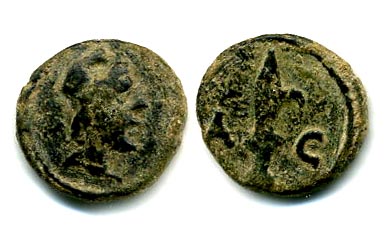
A FORVM post asked for an identification of this coin.

The reverse seems the harpa (sometimes spelled harpe), the unusual sword or sickel used by Perseus to behead Medusa. It was used by other figures, such including Saturn on this Republican denarius, Phanebal, the War Deity, and the fighters of Etenna.

If this coin is Greek, the 'C' is actually a sigma. If so, there is only one possibility for this coin, the mysterious island of Astypalaia.

Nothing seems to be known of this island in ancient times. Wikipedia helpfully says “The island had no particular importance during the ancient age.” The current population is 1238 residents, I imagine the ancient population would have been about the same. It's not a small island, either, 99 square Km.

Numismatically, the odd thing about this island is that it copied the types of Seriphos, the home of Perseus. No one knows why. All of the Perseus coins from the island that I've seen use the regular '&Sigma' sigma, so this coin is an oddity if I've identified it correctly.

Müller incorrectly attributed Alexander III staters and tetradrachms with harpa control mark to Astypalaea. Price cites Noe assigning the tetradrachms to Argos and cites Newell assigning the staters to Salamis. BCD seems to suggest the A/harpa bronzes belong to Argos, leaving Astypalaea with very few types.

There is a museum on the island with ancient coins. Perhaps one day I'll be able to visit. I'm very curious to know if they have any of their early gorgon and Perseus bronzes.

If anyone can suggest another attribution for this coin I'd be very interested.

Sunday, November 05, 2006

AbeBooks.com

Sorry to leave that last post up for so long. It's a downer.

AbeBooks is a website with 100,000,000 books for sale. It consolidates the lists from 13,500 booksellers. Users can browse for authors, titles, and keywords. Results can be sorted by author, title, or price.

Results can also be sorted by 'Newest'. This is useful for finding bargains. Sellers often don't know the market and offer for prices much lower or higher than usual. For example, today I see a copy of SNG Morcom being offered for $15.

If a book is rare -- there are no other copies on AbeBooks -- it makes sense for the sellers to offer the book at some rediculously high price. Maybe shoppers won't know the price is too high, or be in too much of a hurry to care. High list prices also establish the starting point for bargaining.

There are always idiots who enter prices that are oddly high for no good reason. Why did Bob's Books list Sear GCV: Europe for $98.26 when there are plenty of copies at $60. Why did Revaluation Books (UK) offer Wheaton College Collection for $75 when copies are easily had for $6.23 and $10?

I've never sold books through AbeBooks. To become a seller, there is a $25 monthly subscription fee. I sell books (paperback fiction I didn't like) through Half.com, which is free. When listing books for sale on Half.com it tells you what other copies recently sold for. I always ignored that and tried to come 1 cent or 50 cents below the next cheapest copy. If I didn't do that, my books never sold.

Tuesday, October 31, 2006

If you are a writer, you need a will

Novelist Neil Gaiman points out the difficulties folks will have reprinting your work if you die without a will.

(John M. Ford, Gaiman's friend, isn't the same as John J. Ford, the numismatist).

Wednesday, October 25, 2006

Unintentional humorous eBay ad

eBay buys a lot of Google keywords. Chuqui shows us one that is especially inappropriate.

Tuesday, October 24, 2006

Lanz fall auctions

Lanz auctions 131-4 are online at sixbid.com.

Auction 131 is a specialist collection of 832 Carian coins, including some great rarities.

Auction 132 is ancients and 134 is numismatic literature.

Sunday, October 22, 2006

Fellow

Yesterday I became an ANS Fellow. This is a big honor. I'm in good company; David Sear became a fellow at the same time. I had not realized I was nominated, although I see my name at the bottom of a list of 2006 Nominations for office. My biography there says I write legal websites which isn't quite true. I write numismatic websites. I also write software and patents.

Luckily I attended the presentation of Agoranomia to professor Jack Kroll and to hear the lecture by Andrew Meadows, and found out about the nomination, and the election the following day. And my suit was clean. So I went, and was elected Fellow.

Fellows get to vote at the ANS meeting, but it's a one-party system. Fellows vote yes/no on the board's recommendations. There is no electioneering or campaign speeches at the annual meeting.

Wednesday, October 18, 2006

Burachkov's Catalogue of Coins of the Greek Colonies on the Coast of S. Russia, &c.

I received a PDF of Burachkov's Catalogue of Coins of the Greek Colonies on the Coast of S. Russia, &c. (1884) today from a Ukranian visitor to my web site. It's in Russian. I wanted it for the 32 plates of line drawings, several of which were cited in Historia Numorum.

My intention is to extract the plates from the PDF and place them as navigable .JPGs on the web site, linking the citiations in Historia Numorum to the correct plate in Burachkov.

The PDF is large — 124 MB — so I can't place the whole book on the site. If anyone wants to take a crack at OCRing this Russian-language title, or just wants a PDF to read, let me know and I'll mail you a CD-ROM.

http://www.michelvanrijn.nl/ has shut down

Michel van Rijn's artnews site has shut down.

The site claims it was shut down after receiving photo-threats against one of his children.

It was a good site. van Rijn bravely kept the site up in the face of threats against his own life. With the site gone, there is nowhere for disgruntled looters to inform on each other.

Looters — please don't send your dirty laundry to this blog. I don't have many incriminating audio tapes to protect me from the 'art world'!

(via PhDiva and ancients.info)

Sunday, October 15, 2006

Electrum coin of Alexander the Great?

Here is the description of a small electrum coin from Imhoof-Blumer's 1883 book, Monnaies Grecques page 465:

35. El. 10m. Gr. 1,965, limée. – Tête diadémée d’Alexandre le Grand? à g.
Rx. Moissonneur, à dr., dans le même costume, se baissant pour couper le blé avec la faucille. Devant lui cinq, derrière lui trois épis debout. Cab. de France. Pellerin, Rois p. 208, vign. Rec. III, p. 3, pl. 86; Eckhel, D. N. V. IV, p. 25; Mion VI, 34, 269; Lenormant, Rois Grecs, p. 160, pl. LXXXI, I.

Imhoof-Blumer is describing uncertain coins of Asia Minor.

In English, a 1.97g electrum coin, obverse Hd. of Alexander the Great facing left, reverse "Harvester" facing r., in the same costume (short chiton with pointed bonnet), bending down to cut corn with sickle. In front of him five, behind him three ears upright.”

The coin isn't pictured in Imhoof-Blumer's book, and because it is uncertain I don't know what mint to look under in more recent books for a picture. I don't know what the word "limée" means.

Anyway, it seems odd to me that an electrum coin would feature Alexander III. Does anyone recall if this coin type ever earned a more reasonable attribution? I searched ISEGRIM for electrum and gold coins but with people on the reverse but didn't find any with sickle or wheat.

Saturday, October 14, 2006

Index to BCD Peloponnesos

Coins of Peloponnesos: The BCD Collection gets my vote for numismatic book of the year. Although only an auction catalog, it has better text and more interesting coins than anything else I've seen - so far - this year.

The coins themselves are searchable on coinarchives but the printed book itself contains a great deal of descriptive text, new theories, etc.

Today I was looking for coins of Cranii [= Kranion] from the island of Cephallenia [= Kefalonia or Kephallonia] in the catalog. There aren't any coins from the island, but it took me a while to figure this out. I could have realized this a lot faster if I'd used the downloadable index to BCD Peloponnesos. Highly recommended.

I have acquired the catalogs of all of the BCD auctions. The others are Boeotia, Euboea, and Corinth. This collection will be an important reference in the future, at least as important as SNG von Aulock is for Asia Minor, and the volumes are must-haves for collectors of Greek coins.

Trio of matching fourrees


Today's photo shows three ancient counterfeits, all taken from the same dies. The first has intact plating — it was sold as an official mint issue.

Weights 1.57g, 1.97g, 1.99g.

I purchased these over the course of several years. I also have a fourth example, of the same workshop but of another die pair.

Because these coins are from the same workshop any differences in them come from corrosion in the ground and manufacturing variations at the “mint.&rdquo Having three pieces securely from the same mint might be able to illuminate details of the forger's art. Perhaps in a few years when it gets cheaper I'll be able to test them for composition. For example, is the silver plating of uniform composition? Are the copper cores similar in composition? (They certainly aren't in weight.) Maybe these little coins can tell us something about counterfeiting tech in the 3rd-4th centuries BC.

Friday, October 06, 2006

Vinh Phuc: Antiques sold as scrap

Vietnam net Bridge reports Antiques sold as scrap.

These are not classical antiquities, just 400 year old bronze kettles. “The excavators broke the antiques into small pieces and sold them as scrap” for seven dollars and fifty cents per kilogram.

Does this happen all the time? “In 1987, Minh excavated a jar with about 20 kg ancient coins. He used the jar to store rice, and gave the coins to children to play games.”

In stories from the Far East, 'ancient coins' usually means 400-year-old cast 'cash' (the coins with the square holes.)

Thursday, October 05, 2006

Dr. Busso Peus auction

The Dr. Busso Peus auction catalogs arrived in the mail yesterday.

The usual wonderful ancients, but also 754 lots of books, many of which I covet. The catalog is online.

Wednesday, October 04, 2006

Orphan Works Legislation Dead

Photo District News is reporting that the 'Orphan Works Legislation' has been killed, mostly by the photographer's lobby.

An 'Orphan Work' is one whose copyright owner cannot be found. The proposed legislation was going to allow publishers to reprint works if they promised to give the profits to the copyright holder should the author or estate show up to claim it.

(via TeleRead).

Often I'm reading an out-of-print, hard-to-find book and decide it's wonderful and should be introduced to a new generation of readers. It's worthy of a reprint. Unfortunately, no publisher will touch an in-copyright book unless the rights-holder can be found, thus depriving publishers of money and readers of pleasure. So no reprint. Wait for a copy to appear at auction, or beg a photocopy from someone willing to infringe.

Sometimes the author dies or disappears while the book is in print. Authors Registry keeps a list of authors due more than $100,000 in royalties that cannot be found. In some cases this list is rediculous (they claim not to be able to find Bob Dylan) but in most cases the estate is just so clueless as to not know they are entitled to $100,000.

Tuesday, October 03, 2006

Cut Portion of a Silver Dekadrachm


FORVM is offering for sale a cut dekadrachm. The sales blurb suggests that it was cut in ancient times to make change.

A few months ago FORVM offered a dazzling collection of cut coins on eBay, including this and an archaic octodrachm of Abdera. There were so many cut specimens that some lots included more than one piece!

Here are some samples:

Greek Silver - 4 Cut Coins

Kings of Cyprus, Eulthon, 560 - 525 B.C.

2 Cut Ancient Coins, Acanthos? Kelenderis?

Lot of Ten Cut Greek Silver

The eBay buyer is apparently finished with the dekadrachm and is selling on consignment. (I can't recall how much this piece sold for on eBay. I remember a price in the $400s but perhaps am thinking of the octodrachm).

The surprising thing about the dekadrachm is that it is a Hellenistic-era coin. Usually cut coins are very early. Before coinage rough bits of 'hacksilber' were used and some early coins were cut up when they reached pre-coinage regions to join the hacksilber. No word on where all the cut pieces came from, or if they were found together -- did someone collect these over decades, or did they all surface in a single hoard?

It is surprising that this cut piece is so pleasingly centered on Zeus. In The Medici Conspiracy pleasing breaks on Greek vases are a sign of foul play. That shouldn't be an issue here, as no one is claiming that this dekadrachm broke while it was in the ground. It was purposely cut in antiquity, probably by someone who respected Zeus.

(FORVM claims copyright on the photo, used here without permission.)