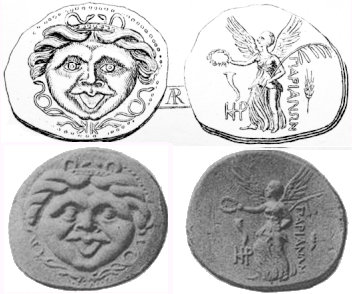
1927 wasn't a big year for numismatic works. The only book published in 1927 that I have read, and that was reprinted, is George Hill's Select Greek Coins. This work didn't become public domain today. It was published in the UK, and already became public domain in 2018 or 2019, 70 years after Hill's passing.
Last week I mentioned the so-called Sponsian gold coin.
Dr. William Hunter began to collect coins in about 1770, spending over £22,000. By the time of his death in 1783 he had 12,000 ancient Greek coins and a similar quantity of Roman coins.
The Greek coins were published the 1890s in three volumes (v1, v2, and v3;
the author was George Macdonald). Some of the coins, like this tetradrachm, are unique.
vol. 2 p. 274 #6, pl. 48 #10) 13.6g 26.5mm
Although hemidrachms of this denomination are common in museum collections, this tetradrachm is unique. Nothing like it has shown up in 300 years.
This unique coin was first published by M. L. Dutens in 1776. George Macdonald assigned the tetradrachm to 200-133 BC – the period before the start of the Cistophoric-weight tetradrachms. Barclay Head dated it post-190 BC. Presumably he chose 190 BC to place the series after the Battle of Magnesia. This dating is odd because the hemidrachms were dated to 400-300 BC. Both Head and Macdonald thought this was 100 years later.
Perhaps MacDonald couldn’t date it to nearer to the hemidrachms because of the weight standard. The weight, 13.58g, is low for a tetradrachm. MacDonald felt the weight standard was 'Rhodian'. He called the gorgon/cow hemidrachm weight standard 'Persic'.
The HR monogram was used on Macedonian Artemis/club tetradrachms (167-149 BC), Macedonian Pan/Athena tetradrachms (277-239 BC), Macedonian prow/Poseidon tetrachms (294-288 BC), Babylon mint Athena/Nike gold staters (336-323 BC), Alexander Balas tetradrachms (Tyre mint, 150-145 BC), and bronzes of Kyme and Seleucis and Pieria. None of those issues seems possible to link to this tetradrachm.
It is possible that this is an 18th century fantasy. It would be worthwhile to look at all of the unique coins in Hunter's collection to see if they have any traits in common. Of all the coins in all the world's museums, this tetradrachm is the one I'd most like to inspect in person.
The “Sponsian” coin might be legit. I don't think it is Roman, and I don't think any Romans had an emperor named Sponsian.
The artistic style doesn't look Roman, nor does it look like the bronze barbarous radiates struck in Gaul imitating Roman coins.
What it looks like is this:
4.7g, 19.5mm
This is a gold aureus. It is from Andrei Sergeev's collection and currently in the State Historical Museum in Moscow. The photo is from the book Barbarian Coins on the Territory Between the Balkans and Central Asia (Moscow 2012; it is coin #224). It is with other coins found 'between the Balkans and the Dnepr basin'.
This coin has the obverse inscription ZZNZZTWZ ... ONIIƧWZNƧ.
Sergeev's catalog includes four other Ukrainian gold aurei from the same period. They are called Roman imitations, and perhaps they are, but perhaps they are not. They sometimes have pseudo-Roman inscriptions like IMPM... AXMINV.
2.7g, 18mm
Here is a silver coin find, said to have been found on the territory of western Ukraine, Khmelnytsky region near the Dnister river. This is about 500 km from Translyvania where the "Sponsian" coin was found. According to Vital Sidarovich, this type has also been found in south-west Belarus, in the area of the Wielbark culture. Often these types imitate Roman emperors, but this one doesn't seem to.
It is not clear if the inscriptions are portraits are always imitations of things seen on Roman coins. There is no reason they couldn't depict local chieftans.
Elsewhere, Barry Murphy has suggested the Sponsian coin is a cast imitiation. I haven't inspected it personally, but it looks struck, but corroded which gives it a cast look.
I tried to XRF an archaic Greek coin in an NGC slab.
I got very strange results: LE 97.82%; Ag 2.15% (Silver); Au 0.024% (Gold); Pb 0.010% (Lead)
LE stands for “Lighter Elements”. For this machine, this means Mg, Al, Si, P, and S. (The machine has a way to break this down, but it isn’t my machine, and I didn’t figure out how in the time that I had.)
Using similar calculations, gold is 1.1% and lead 0.5%. Those figures are about right for the 3.9g series of “Parion” (actually Thracian) coins.
Perhaps it is possible, with machine settings or calculations like the above, to perform XRF through slabs. Has anyone tried it before and after cracking slabs? Is there a technique that works?
Not all of the coins had been photographed, but the best 10% were. The International Association of Professional Numismatists (IAPN) published these in a special bulletin. That publication, Coins Stolen from the National Archaeological Museum, by Jean-Paul Divo (1937-2014), is rare.
A brief UPI story (no byline) from December 1980 says that authorities recovered US$40,000,000 of “ancient Roman coins, jewelry and artifacts” including a rare coin of Augustus worth $1.3 million alone.
It's unclear how many coins were recovered. The recovery included the Naples museum coins as well as coins stolen from the Antiquarium Museum at Pompeii in 1975. The UPI brief mentions 71 recovered coins.
Although the UPI claimed a single recovered coin of Augustus was worth US$1,300,000, I am uncertain what that coin could be. Only one Roman Imperial coin has sold for over a million dollars. The coin was a sestertius of Hadrian engraved by the Alphaeus Master that sold for $2.5 millionin 2008. A million-dollar Roman coin value in 1980 seems unlikely.
(A brief AP story on the Pompeii robbery (also no byline) says that robbery included “a large number of gold and silver jewels and coins”.)
UPI said in 1980 that five men had been arrested, including one who once worked as a watchman in the museum. The accused were not named and I could not find a follow-up story on any conviction or sentencing.
Jean-Paul Divo's catalog of the stolen coins is very rare today. I've only seen it offered twice; once in a group lot in Rick Witschonke's library sale, and another copy was sold on VCoins by ANE for $75.
If anyone knows what happened to the five suspects please let me know.
I hope that one day Divo's catalog will be reprinted, or that the Museo Archeologico Nazionale di Napoli, IAPN, or Divo estate make a list of the missing coins available online. A single coin that matched one of the stolen pieces could provide valuable clues as to where the rest of the loot ended up.
Next weekend, Friday-Sunday, is the FLAME Conference at Princeton university. The conference is both in-person and virtual.
Sunday will feature a panel on "digital numismatics" with Ethan Gruber (ANS), Dr. David Wigg-Wolf (German Archaeological Institute), Mark Pyzyk (Princeton University), and Pavle Jovanov (FLAME freelancer at Princeton).
For more infor on FLAME see https://coinage.princeton.edu/.
rNumis.com has been steadily adding digital auction catalogs for several years. As of January 2, they have
a database of 4565 catalogs, 1579 of which include links to digital versions of the catalog.
The site also includes a proof-of-concept provenance research tool for Greek coins of Italy and Sicily. There is no full-text search but the coins of each Greek city can be filtered by weight and metal. Best: if a coin has multiple auction apperances, such as this Akragas tetradrachm, the full auction chain is displayed.
This site is an important resource to numismatic researchers. Merely by curating links to online coin catalogs on file sharing sites such as issuu.com and research library archives such as HEIDI the site saves time by making it easy to learn if a particular catalog is online.
Even when I own a physical copy of a catalog, I find it easier to use digitized ones. My physical libary is mostly either mis-filed or in boxes in my attic! Digital copies save a very dusty trip.
The provenance tool is an interesting start. I have not used it much. The tool includes photos and metadata about 4926 ancient Greek coins of Italy and Sicily, scraped from public-domain auction catalogs. The concept is similar to the the important but sadly obscure photo-file of the American Numismatic Society. The ANS effort, which took decades of work, covers 268,000 coins. rNumis currently has only 2% of that scope. Yet that is 2% is online and growing.
I have been building a library of numismatic auction catalogs covering my areas of interest for many years. Due to limited shelf space I don't acquire catalogs that are already online in acsearch.info. At this point rNumis is good enough that I will no longer be buying catalogs if rNumis can reveal a digital copy.
I encourage numismatic researchers to check out the site. The operator is friendly and seems to be open to suggestions. Don't miss the catalog sale section for enlarging your own literature collection.
D.F. Grotjohann, who has a VCoins store until about 2010, is now selling ancient coin NFTs at https://opensea.io/DFGrotjohann.
He has 13 ancient coins listed as well as two samurai cartoons. One of the coins is a nice looking Alexander Octodrachm. The price is 3.5. The currency of that price is Ethereum, which works out to US$15,532.
The buyer receives the ancient coin in addition to the digital rights.
National Geographic gives a detailed look at how currency counterfeiting is done in the underworld of Lima, Peru. Mariana van Zeller interviews a convicted printer, visits a currently operating printer and as well as a finisher. A money mule explains how to sneaks cash into the US.
The upper coin sold for about $300+fees. The lower coin sold for about $600+fees. I do not have access to the coins, I merely stumbled across the photos online.
My first impression was that I was looking at two different coins. At least one of the coins is a modern cast forgery.
Several people suggested that it was more likely that both pictures show the same coin, before and after a 'repair'.
I am curious what my readers think. In the comments, tell me if you think these are one or two coins, genuine or fake, repaired or not. I can tell you that the reported weights are within 0.3%.
Most Harlan Berk catalogs for Buy or Bid sales 168 to the present and Gemini VI through XIV are available on issuu.com.
These are the catalogs issued in the last 11 years.
I haven't been able to find the earlier ones online.
This item isn't news -- they have been there for a while -- but it took me a while to find them this morning.
What can artificial intelligence and image processing tell us about coins? Zachary Taylor of the American Numismatic Society gave a walkthrough in April of 'CADS'.
I was intrigued by the ideas of calibrating feature extraction by sizing a circle and throwing away everything outside the circle. I hadn’t thought of it myself — the die study I am attempting is on a series where the die is larger than the coins. It seems like an ingenious hack given how feature extraction works. Taylor also suggested that the images should be cleaned up — I think he mentioned removing backgrounds — but if the software removes everything except the center there is no need to remove backgrounds at all.
Greek coins, and many Roman coins, suffer from dies that degrade faster near the edges than the center. Only using the middle of the coin may help to keep degrading dies "together" in the tree (dendrogram) view later.
Taylor next showed setting the “blur radius” until the image looks “cartoonish”. He called the CADS kind of blurring “median blur”. This seems like a good idea. I suspect it could be done automatically with a small bit of work rather than requiring a human operator. Taylor said this was to remove circulation wear. I suspect this also makes the analysis more resistant to photographic and lighting concerns.
The next thing is what he calls “feature detection”. CADS uses OpenCV, which has been under development for a couple of decades. Taylor says using feature detection came from Huapeng Su’s earlier ANS CADS prototype. A 'feature' is just a contrast pattern of light and color, not something a human would call a 'feature' like a helmet decoration or nose shape. OpenCV tutorials suggest features represent “corners” — small regions on the image where the contrast changes a lot, and changes differently from nearby regions.
The coins CADS has been tested on seemed to be all VF-XF condition. I will be curious to see how it does with coins with a wider range of conditions. I was wondering if the blur could be different for each coin, with less blur being applied to lower grade coins.
The next step is calculating the “distance metric” between all coins. I suspect the computational complexity is N^2 to the number of coin images. He described this as “brute force Hamming method”, with the “20 best matches condensed into 1”, “agglomerative nesting” with “no risk of overfitting”. Taylor said CADS uses Oriented FAST and Rotated BRIEF (not SIFT). I am not a computer vision guy and only know the meaning of some of those terms … but OpenCV provides a library for all of these things: https://docs.opencv.org/master/d1/d89/tutorial_py_orb.html . Taylor’s work seems to be choosing to use that library and tuning the parameters rather than implementing a distance calculation from scratch.
Taylor said the algorithm to compute the distance metric takes “a few hours” for 3000 owls and he showed it taking less than a minute for about 100 Paphos tests. This also suggests the performance is N^2.
The next piece is the dendrogram graph, which looks nice. (It might just be the dendrogram feature of the Javascript library D3 https://www.d3-graph-gallery.com/dendrogram ?)
Taylor described the dendrogram sub-trees as representing dies if tuned correctly. I suspect his algorithm will also group coins from the same die by “die state”.
The “card view” letting the user quickly flip between all the children at a point in the dendrogram looked good. I suspect the card view would be greatly improved if the images were rotated and scaled so that the matched features of all coins on the card line up as close as possible.
After Taylor's demo, Alan Stahl showed Princeton’s work on the topic. He had previously shown this work at the New York Numismatic Club. Princeton’s approach has at least two key differences.
Stahl’s team used a complex physical technique to get the 3D height of the object. It is a great technique but it may not get traction because of the difficulty performing it and getting access to the coins. Yet it is worth pointing out that the CADS approach has only been tested on (over?)-cleaned silver coins. Bronze coins and coins with a lot of toning may not work directly with CADS — photographs of plaster casts may needed to get good results from CADS if patina variations overwhelm “feature detection”. If that is true then the Princeton approach not look so difficult compared to CADS for those series.
Stahl was concerned about the file size of his images. I suspect he could just use the calculated “height” as a greyscale pixel values and store his images as black-and-white JPEGs. That would reduce the image size to normal and I suspect it would let him use Taylor’s workflow directly.
Princeton had humans annotate manually some interesting points on the coins. This is labor intensive! Yet manual annotation might have some merit being used in conjunction with the Taylor approach. It might be that the CADS approach has a hard time “connecting” worn coins, partly reworked dies, or lighting techniques. Perhaps after CADS has reduced the 3000 obverses to a hundred “dies” the Princeton approach of manually marking points could be used on CADS-identified dies to find further matches that CADS missed.
I was disappointed that after all of these years the ANS and Mr. Taylor only managed to look at two series of ancient coin types. Taylor said this isn’t a problem because the “learning” is unsupervised.
Portugal, uncertain year. David Oliveira. 315 g; 3.5” / 89mm
The obverse of this medal depicts the bronze statue of former dictator António de Oliveira Salazar of Portugal. The statue was beheaded with dynamite during the 1974 “Carnation Revolution”. The revolution, a military-led coup d'état, started on April 25, 1974, and replaced the dictatorship with a democracy after a two-year transitional period.
The reverse shows rubble on the pedastal after the explosion, with an a question mark in the shape of Salazar's profile in the shape of a question mark.
The statue’s head has been stored for over 30 years in the attic of City Hall in Salazar’s city of birth, Santa Comba Dao, Portugal. There is current discussion that the statue be restored and placed in a newly planned Salazar museum.
Saturday, May 30, 2020
George Floyd, the Minnesota man who died last week during a botched arrest, was been accused by some reporters as being wanted for the forgery of a $20 bill.
"Forgery" would mean he made it himself. He was accused of passing a forgery, knowingly or unknowingly. Most people don't even look at their change, they just spend it at the next place.
According to August 2019 article, the U.S. Secret Service is working with [Minnesota] retailers to stop the flow of counterfeit money coming into the Twin Cities. If cashiers, who work with money all day long, need education to spot fake notes why should anyone expect that a regular citizen would recognize it? I have the skills to detect counterfeit currency, but since the pandemic I have been touching the bills I receive as little as possible. https://minnesota.cbslocal.com/2019/08/13/trying-to-be-very-aware-twin-cities-retailers-on-lookout-for-counterfeit-cash/
Here is a January story on $900,000 of counterfeit US currency seized by Customs and Border Patrol in Minnsota. https://www.kare11.com/article/news/local/counterfeit-bills-seized-at-minnesota-border-international-falls-china/89-920a8623-b78c-4d52-a735-6eb913ffd98d
Indo-Greek, Menander I (165-135 BC), drachm 2.34g 16mm
The obverse Greek inscription: ΒΑΣΙΛΕΩΣ ΣΩΤΗΡΟΣ ΜΕΝΑΝΔΡΟΥ (Basileos Soteros Menandrou; of King Menander, the Savior)
The reverse Kharosthi inscription: 𐨨𐨂𐨱𐨪𐨗𐨯 𐨟𐨟𐨪𐨯 𐨨𐨅𐨣𐨪𐨯
The reverse inscription usually appears in coin catalogs as Maharajasa tratarasa Menamdrasa; “The Savior King Menander”. The Kharosthi might appear in a table at the end. It's real text here. (You may need a font to see it.) You can cut and paste it to other documents.
One of my hobbies is trying to put coin inscriptions into computer format. Hopefully I came close. Step one was glancing at the Unicode Kharoṣṭhī proposal, especially the table at the end.
This is what I came up with:
Ma-u-ha-ra-ja-sa 𐨨𐨂𐨱𐨪𐨗𐨯 𐨨𐨂𐨱𐨪𐨗𐨯 ta-ta-ra-sa 𐨟𐨟𐨪𐨯 𐨟𐨟𐨪𐨯 Ma-e-na-d-ra-sa 𐨨𐨅𐨣𐨪𐨯 (using a zero-width space to help position; using ra instead of the compound dr) 𐨨𐨅​𐨣𐨪𐨯
A Gift for Polydektes blog is excited to announce that Dr. Jonas Emmanuel Flueck will be presenting a detailed look at the ancient coin provenance searching software Ex-Numis via Zoom later this month.
The presentation will be Saturday May 30th 1pm EDT. To attend please RSVP Ed Snible. This presentation is hosted by the Bronx Coin Club and the Ancient Numismatic Society of Washington DC.
Dr. Jonas Emmanuel Flueck created a computer system that uses digital image recognition to match coin images to an extensive database of sales catalogs. Five years ago he founded Ex-Numis, a provenance rediscovery service for ancient coin collectors and dealers.
Dr. Flueck will tell us about the importance of provenance for both legal and scholarly reasons, his technology and database of almost one million ancient coins, and what he has learned about provenance in today’s ancient coin market.
Dr. Jonas Emmanuel Flueck is the executive director of the auction house “Lugdunum GmbH” (Switzerland); a former treasurer at the IAPN; the general secretary of the Association of Swiss Professional Numismatists; and the founder of Ex-Numis.
On March 24, 2020 archive.org released for unlimited borrowing the 1.4 million book titles they call the National Emergency Library.
They believe the global pandemic justifies their action. (They give their legal and moral justification here.)
The National Emergency Library is not just medical books. It is everything they have. For the duration of the emergency you can download all kinds of amazing things. Here is a list of their numismatic holdings by decade. It includes some very rare auction catalogs and club journals.
I encourage everyone looking for an at-home project to consider finishing your own numismatic works and prepare them for publication. Stay home. Use this library for research during the pandemic.
Object lot provenance published to Mantis
-
The migration of the American Numismatic Society collection database to
CollectiveAccess has enabled significant enhancements in the usability and
search...
True Journalism
-
Media in our day and age has a profound effect on the mood of our country
and the path taken by citizens and legislators as well. In recent years,
some ha...
Those book cards
-
Although it seems old fashioned — well let us be honest it is old
fashioned! — the cards which are used to lend books to members are a
fascinating historic...